
- Most powerful commercially available oxidizer
- Powerful disinfectant and sanitizer
- Applied in numerous industries
- Green technology – replaces chlorine and other chemicals
- Made from Oxygen (O
2converts to O3) - Economical – no additives required
- Studies are available for most applications
Ozone is an advanced Oxidizer – created from Oxygen – that is applied in industries including aquaculture, odor control, medical treatment, disinfection, pollution control, dentistry, manufacturing, swimming pools, laboratories, hospitals, zoological, municipal water treatment and numerous others. It has been in constant use since it’s discovery over 100 years ago. It can be used to complement or replace chlorine or other chemical-based treatment systems. In applications where the elimination of chlorine is the goal, Ozone is the technology of choice.
Advantages:
- Fastest Commercial Oxidizer available – more powerful and faster-acting than chlorine or other chemical-based oxidizers and sanitizers.
- Ozone is generated with Ozone Generators – you never pay for chemicals or additives.
- Environmentally Responsible – Ozone is oxygen-based, not chemical-based and does not degrade into harmful by-products.
- Systems are reliable and low-cost in comparison to other chemical technologies.
- Ozone has been in commercial use for over 100 years – systems are well understood and applications are well documented.
Oxidation and Disinfection:
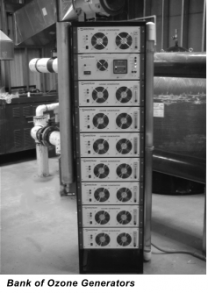 Ozone or O3 provides advanced oxidation and disinfection in applications ranging from water treatment to odor control. Ozone is the fastest acting oxidizer and sanitizer available for commercial or industrial use. Because of this, Ozone has found a home in numerous industries. Ozonated swimming pools can eliminate or reduce the need for chlorination and it’s attendant health problems. Most of the commercial applications of Ozone are aimed at replacing chemical-based oxidizers such as chlorine and sanitizers with a more powerful faster-acting alternative. Besides its powerful oxidizing and sanitizing capabilities, since Ozone is oxygen-based, it is inherently much healthier and safer than a chemical-based system. Ozone is the fastest-acting commercially-available sanitizer and oxidizer on the planet. It is a much faster oxidizer than chlorine, fluorine or or other chemical oxidizers.
No Chloro-Organic Byproducts
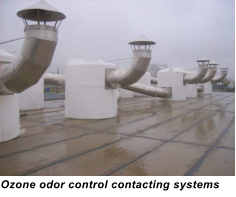 Most of the health issues with chemical systems arise from disinfection or oxidation byproducts. That is, when chemicals react, they often break down into substances that are very harmful. Chloro-organic by-products are often much more dangerous than the original substances. In fact, many of these byproducts contain recognized carcinogens. With Ozone, which is an oxygen-based sanitizer and oxidizer, the reactive third Oxygen molecule simply reverts back to the more stable form of Oxygen.
Application Expertise
Envron Ozone is dedicated to helping you find the right oxidation or sanitation solution based on your needs and the recognized ability of Ozone to work within your particular application or process. Besides full-scale process systems, Envron can provide bench-scale and pilot-scale systems for testing or prototyping.
Chlorine Replacement
Ozone is one of the most useful, ecologically sensible substances on planet earth. In it’s “raw” form in nature, it is essential for all life on this planet. Without the Ozone layer, we wouldn’t exist. Ozone is Mother Nature’s supreme disinfection and cleansing agent. It is a superior oxidizer and sanitizer and works much faster than chlorine. Chlorine replacement is one of the chief uses of Ozone.
Applications
Ozone is one of the most studied technologies on the planet and has been in constant use since its discovery over 100 years ago. As with any technology, there are situations where Ozone can accomplish a great deal. And while Ozone systems are for the most part mechanically quite simple, the science and chemistry behind successful Ozone application requires experience and application expertise. For chlorine replacement or in situations where chlorine is not acceptable, Ozone is one of the replacement of choice.
Envron – Ozone Expertise
Because Ozone is one of the most studied technologies on the planet, it is doubtful you are coming up with a “new” use of Ozone. Chances are, someone has already applied (and studied) Ozone for what you are attempting to accomplish. If you truly have a unique application for Ozone, we can assist in establishing a pilot study to see whether this technology can be used in your situation. In general principles, Ozone can replace most Oxidizers on the market and bring you a total cost savings. These include oxidants such as chlorine, flouride, Hydrogen Peroxide and others.
Please do not hesitate to contact us with your questions about this technology. We’ll be happy to assist you in your search for the proper application of this extremely useful technology.